The Overlooked Nutrient Behind His Recovery
Doctors Said He Needed New Knees. Instead, This Veteran Found the Nutrient Most Folks Miss
Twenty-six years of airborne infantry and decades behind a big rig wrecked his knees. Today, at 81, he climbs in and out of his tow truck seven days a week.
By Elizabeth Smart, Daily Health Digital Correspondent
Published October 3, 2026
Robert, 81, still climbing in and out of his tow truck seven days a week.
Robert hadn't slept through the night in three years.
It was his knees. Every time he rolled over, they'd send a jolt through his body so sharp it snapped him awake.
And once the pain started, there was no going back to sleep.
By 2 a.m. most nights, he'd given up trying.
He'd sit on the edge of the bed in the dark, hands gripping the mattress, waiting for the grinding in his kneecaps to ease enough to stand.
Then the shuffle to the bathroom. Grip the doorframe. One step. Stop. Wait. One more.
His wife had stopped asking if he was OK. She already knew the answer.
Twenty-six years in the military had done this to him — airborne infantry, then decades behind the wheel of a big rig, climbing in and out of cabs ten, fifteen times a day.
By his mid-70s, the damage had caught up with him in a way no amount of toughness could push through.
His doctors told him he needed new knees. Both of them.
He'd taken glucosamine for over a year and felt nothing.
Tried turmeric, fish oil, collagen powder — spent hundreds of dollars on supplements that promised everything and delivered nothing.
The cortisone shots were the worst part: two weeks of hope, then the grinding came back worse than before.
By 78, Robert was spending sixteen hours a day in his recliner. Not by choice. It was the only position that didn't hurt.
He'd pretty much accepted this was how the rest of his life would go.
He was wrong.
Today — at 81 — Robert works seven days a week.
He climbs in and out of his flatbed tow truck without a thought.
He hugs his grandkids without bracing himself.
He hasn't reached for a pain reliever in over a year.
What changed wasn't surgery, wasn't a new prescription, and wasn't some miracle exercise his doctor recommended.
It was something he found at 2 a.m. on a forum — a single comment from a stranger that led him to a discovery most doctors have never heard of.
The Comment That Stopped Him Cold
What happened next is the reason you're reading this article.
In Robert's own words:
"I was up late, my knees keeping me awake, just looking around online for anything I hadn't tried yet. I ended up on some forum where folks were talking about the same things I was dealing with. And somebody — I don't even remember who — wrote something that stopped me cold."
"They said the problem wasn't the cartilage. It was that the joints were drying out. Like the fluid inside them was disappearing."
"I'd never heard anyone put it that way. Not my doctor. Not the orthopedist. Nobody."
"I sat there reading that comment over again. And then I started digging."
Why Robert's Doctor Never Mentioned It

Joint drought (left) vs. a healthy, fluid-filled joint (right).
What Robert had stumbled onto sounded strange at first.
But it wasn't fringe science.
It was the foundation of nearly forty years of research from a team of scientists in Spain — research that had quietly transformed how a small group of doctors think about aging joints, but had barely made it into mainstream American medicine.
They call the underlying problem joint drought.
And once you understand it, you understand why everything Robert had tried — and probably everything you've tried — has been working around the edges of the actual issue.
What Spanish Scientists Found Hiding in Plain Sight
For decades, joint researchers focused on the same things: cartilage, inflammation, bone density.
The entire field was built around the idea that joints break down because of wear and tear — and that the answer was to rebuild or protect the cartilage.
But a pharmaceutical research team based outside Barcelona — at a company called Bioiberica that's been studying joint biology since 1975 — took a different approach.
They didn't focus on what was breaking.
They focused on what was drying out.
Specifically, they studied synovial fluid — the thick, lubricating liquid that fills healthy joints and allows them to move smoothly, absorb impact, and bend without friction.
Here's what they found:
In aging joints, the problem usually isn't that cartilage has been "destroyed."
It's that the fluid surrounding and protecting that cartilage has slowly evaporated — becoming thin, stagnant, and insufficient.
Your joints are running dry. From the inside out.
Joint drought begins as early as your 40s and accelerates with every decade.
When that lubricating fluid dries out, the soft tissues inside your joint start rubbing against each other — creating friction, resistance, and that telltale grinding sensation — like a door hinge that hasn't been oiled in years.
That's the stiffness you feel when you first stand up.
The ten minutes on the edge of the bed every morning before your knees will cooperate.
That's not worn-out cartilage — it's a fluid problem, which needs a different approach.
But the physical stiffness is only part of the story.
There's also the heat.
That deep, irritating burn that settles into the joint — the kind that makes you want to reach for ice even when you know it won't really help.
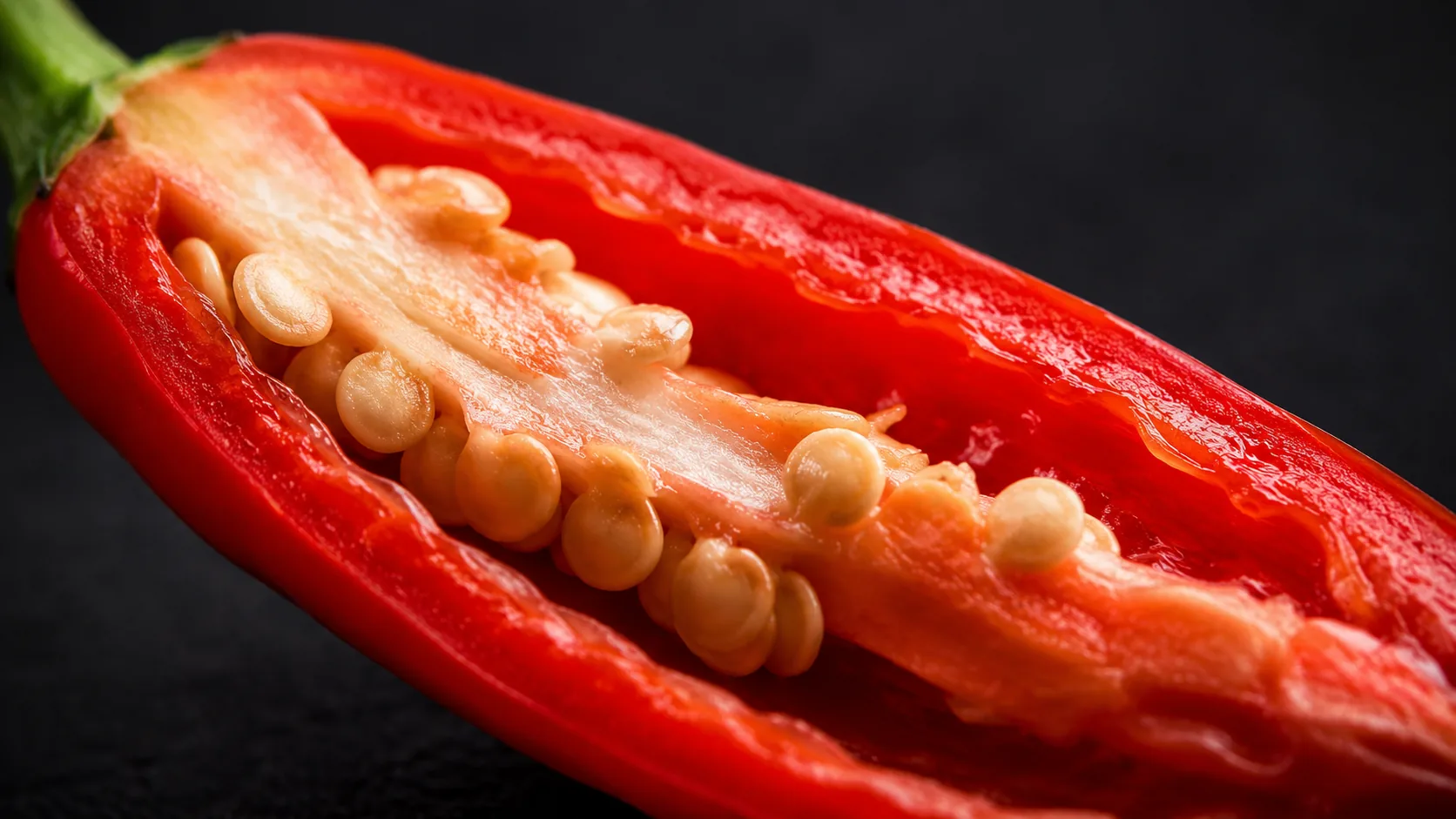
TRPV-1 — the molecule that makes chili peppers burn — is the same compound that accumulates inside dried-out joints.
Researchers at Cambridge University discovered why.8
As joint fluid depletes, a molecule called TRPV-1 builds up in the joint space. You've probably never heard of it — but you've felt it.
It's the exact same compound that makes chili peppers burn.
Which is why ice packs help for a few minutes. They're cooling a chemical burn. They're not addressing the drought that keeps producing it.
That's what's happening inside millions of joints right now.
A slow drought, chemical buildup, and a stiffness that nothing on the shelf was ever designed to address.
Until a team of Spanish researchers asked a different question entirely.
They'd spent nearly a decade studying one specific problem: could a dried-out joint be coaxed into making fresh fluid?
After nearly a decade of research, they found the answer.
And it came from one of the most unexpected sources imaginable.
The Overlooked Nutrient That "Floods" Aging Joints With Fresh Fluid

Rooster combs contain one of the highest natural concentrations of hyaluronic acid found in nature.
The breakthrough ingredient didn't come from a lab-created molecule or an exotic plant.
It came from rooster combs — the fleshy crest on top of a chicken's head.
Now, this may come as a surprise, but rooster combs contain one of the highest natural concentrations of hyaluronic acid found anywhere in nature — the exact same substance your body uses to make synovial fluid.
When scientists made that connection, the supplement industry took notice.
If hyaluronic acid is what keeps joints lubricated, the thinking went, why not simply take more of it in pill form?
It was a reasonable idea. Hundreds of products were built around it.
There's just one problem.
Hyaluronic acid molecules are large and fragile. When you swallow them, they get broken down during digestion — and very little, if anything, makes it to your joints in a form your body can actually use.
The Spanish team at Bioiberica spent years cracking this problem.
They came up with a patented process that protects the hyaluronic acid from digestion so it actually reaches your joints intact and ready to work.
They called the result Mobilee®.
And instead of just delivering hyaluronic acid to the joints, Mobilee® does something no other joint supplement does:
It triggers your body's own cells to produce fresh joint fluid naturally.
In clinical testing, Mobilee® was shown to increase your joints' own natural production of hyaluronic acid by up to 10 times.2
Not 10 percent. Ten times.
That's the difference between white-knuckling the handrail on the way downstairs and moving through your own home like it's yours again.
It's no surprise then that in a randomized, double-blind, placebo-controlled human trial, subjects taking just 80mg of Mobilee® per day experienced3:
A significant reduction in joint discomfort
Less synovial effusion (swelling inside the joint)
Improved muscular strength around the knee
And they felt the difference in as little as 90 days — at a dose small enough to fit in a single capsule.
But this was only the beginning of the story.
The Doctor Who Connected the Dots

Dr. George Karanastasis, physician and former research fellow at the Harvard-affiliated Beth Israel Deaconess Medical Center.
When Dr. George Karanastasis first read about the Bioiberica team's work, he wasn't looking for a business opportunity.
He was looking for an answer.
A physician and former research fellow at the Harvard-affiliated Beth Israel Deaconess Medical Center,1 Dr. Karanastasis had spent over 20 years watching the same pattern repeat itself.
Patients would try glucosamine, turmeric, cortisone shots — get temporary relief, then end up right back where they started.
He knew the standard explanations — wear and tear, inflammation, cartilage loss — were real. But something was missing.
When he found the Spanish research on synovial fluid depletion and Mobilee®'s ability to trigger the body's own fluid production, it finally clicked.
"The fluid was the starting point. Not the cartilage. Not the inflammation. Everything downstream depends on the fluid — and nobody was addressing it."
But the more he studied it, the more he realized Mobilee® alone wasn't enough.
Restoring fluid production addressed the drought. But two other problems were still running in the background.
And if he ignored them, they'd undo everything the fluid restoration had achieved.
To understand why, you have to know something about synovial fluid that we haven't mentioned yet.
Up until now we've talked about it as a lubricant — the liquid that keeps joints moving smoothly.
But lubrication is only one of its jobs.
It's also a delivery system, bringing oxygen and nutrients directly to the cartilage, which has no blood supply of its own and depends entirely on the surrounding fluid to stay healthy.
And it's a waste removal system, continuously flushing out the toxic byproducts that accumulate in the joint space — including the same TRPV-1 compounds responsible for that deep burning sensation.
When the fluid depletes, all three systems fail at once.
Joints lose their lubrication.
Cartilage stops getting fed.
And toxins stop getting cleared.
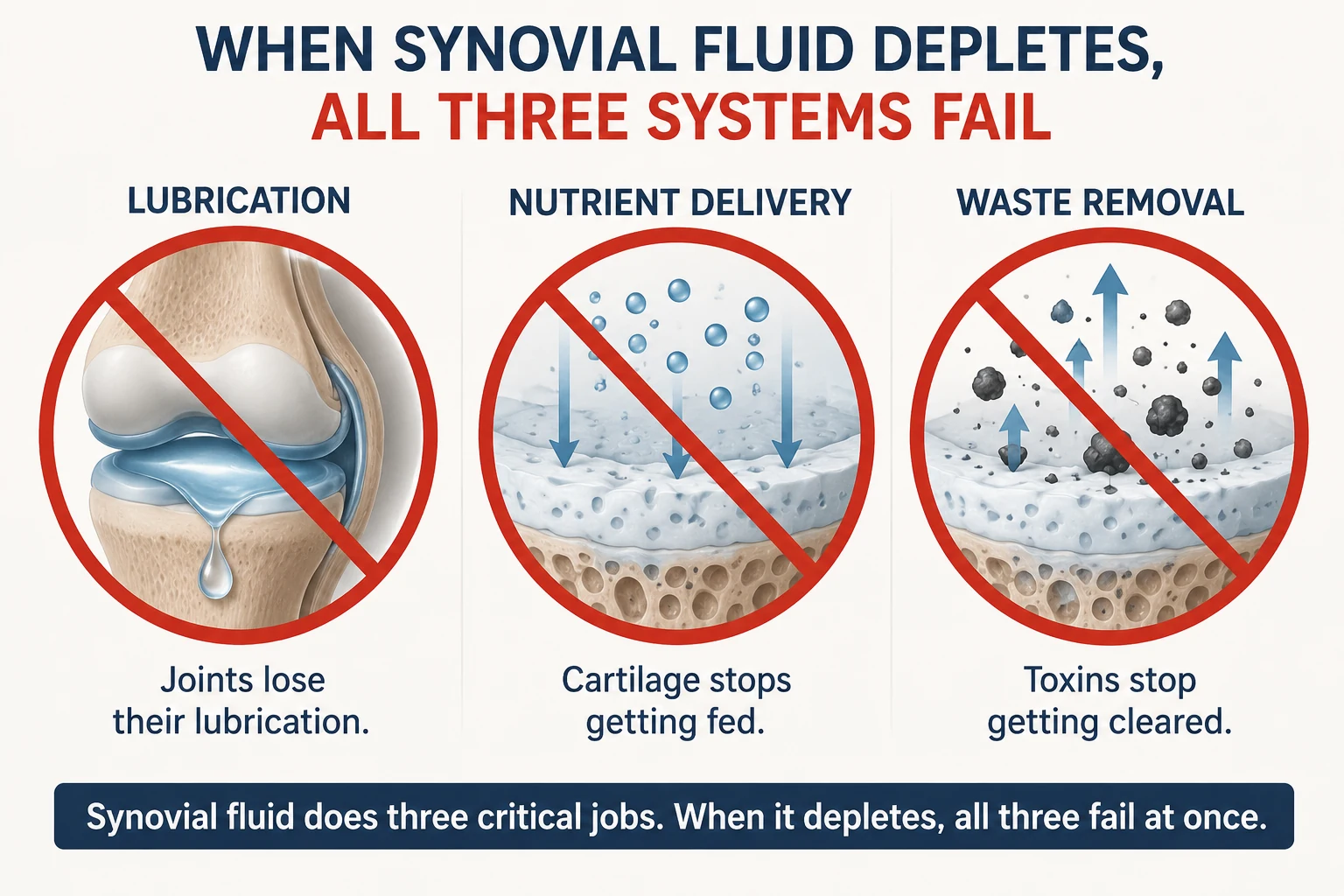
Synovial fluid does three critical jobs. When it depletes, all three fail at once.
That's when cartilage breakdown begins.
Starved and exposed, its surface starts to wear. Slowly at first, then faster.
Eventually the inner layers get exposed.
And because the immune system doesn't normally come in contact with these inner layers, it treats them as foreign tissue and attacks them.
This breaks down cartilage even further.
It's a vicious cycle. The drought causes the breakdown.
And as cartilage breaks down, the debris it sheds contaminates what little fluid remains — making it thicker, more toxic, and less able to do its job.
In other words, the breakdown worsens the drought, which causes even more breakdown.
For the person living inside that cycle, it means one thing: every month that passes, the mornings get harder. The stairs get steeper.
The things you used to do without thinking — getting out of a chair, walking to the mailbox, reaching for something on a high shelf — start to take a plan.
That's what Dr. Karanastasis kept seeing in the people he worked with.
And it's what drove him to find something that could interrupt that cycle — not by masking the inflammation it produced, but by slowing the breakdown at the source.
He found it in a compound called Collavant n2® — a bioactive form of native type II collagen developed by the same Bioiberica team, derived from chicken sternum.

Collavant n2® — a patented form of native type II collagen derived from chicken sternum.
Unlike the collagen powders lining supplement shelves, Collavant n2® is specifically processed to survive digestion intact.
Once absorbed, it works with the immune system to slow the cartilage breakdown cycle — rather than triggering it further.
In clinical trials, subjects taking Collavant n2® experienced a 50% reduction in walking discomfort.4,5
Think about what that means in a day.
Getting up from a restaurant chair without bracing yourself on the table.
Walking through a parking lot without calculating the closest spot.
Making it through a grocery run without that familiar ache setting in halfway down the aisle.
They also showed 70% slower progression of joint stiffness4,5 — meaning the slow tightening that had been stealing a little more mobility every month was effectively put on pause.
The mornings that had been getting harder, month after month, stopped getting harder.
But there was still a third problem.
Even with fluid restored and cartilage protected, the inflammatory chemicals that had accumulated in the dried-out joint space were still there — still irritating, still producing that deep burning sensation that ice packs can only temporarily cool.
Dr. Karanastasis needed something that could clear out that toxic buildup — calm the inflammation without just masking the symptoms the way a painkiller would.
His research led him to Boswellia serrata — frankincense resin. Ancient practitioners used it for joint problems for thousands of years.
And for good reason. Unlike most anti-inflammatories that work broadly across the whole body, Boswellia goes after the specific type of inflammation that builds up inside dried-out joints.

Boswellia serrata — frankincense resin. Its active compound targets the specific inflammation found in dried-out joints.
The challenge was dosing. The active compound in Boswellia — a molecule called AKBA — makes up only about 2-3% of raw frankincense.
The ancient practitioners compensated by using large amounts of resin over long periods of time. It worked — but slowly. Weeks. Sometimes months before they felt a difference. And not something you can fit in a capsule.
Then he came across ApresFlex® — a next-generation Boswellia extract that solved the dosing problem entirely.
Instead of 2-3%, ApresFlex® concentrates the AKBA to 30%. And the body absorbs 51% more of it than conventional extracts.
The result, in clinical studies: noticeable relief in as little as 5 days.6,7
Not weeks. Not months. Days.
With continued use, subjects experienced 65% less soreness — the kind of difference where you stop dreading the end of the day because your knees have been punishing you since noon.
54% better function — meaning the things that had quietly dropped off your list, like kneeling in the garden or playing on the floor with grandkids, start coming back.
And 38% greater mobility — the kind where you catch yourself taking the stairs without thinking about it, and only realize afterward what you just did.
Three problems. Three targeted compounds. Each one addressing what the others couldn't.
Dr. Karanastasis had his formula.
He called it Arthrozene.
One capsule. Once a day.
What the Clinical Research Shows
Based on peer-reviewed, placebo-controlled human trials
Joint Fluid Production
Increased by up to 1,000% — Mobilee® (Castillo et al., 2010)
Walking Discomfort
Reduced by 50% — Collavant n2® (Bakilan et al., 2016)
Stiffness Progression
Slowed by 70% — Collavant n2® (Di Cesare Mannelli et al., 2013)
Soreness & Discomfort
Reduced by 65% — ApresFlex® (Vishal et al., 2011)
Individual results may vary. These statements have not been evaluated by the FDA.
Robert's First Morning Without Pain
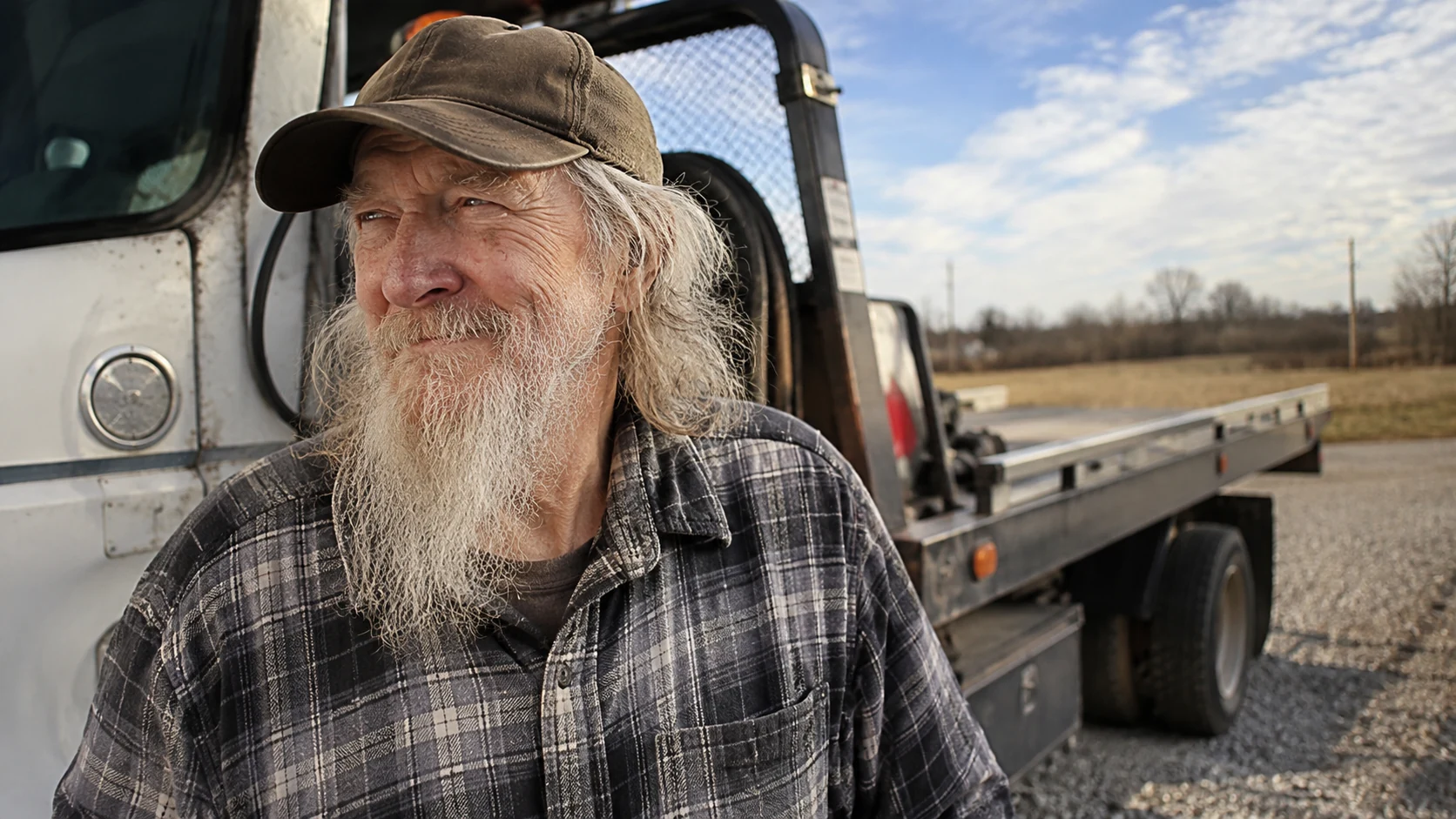
Robert, 81, back at work seven days a week. "The only thing I regret is not finding that forum comment ten years sooner."
Robert decided to try it.
He'd tried everything else.
He figured this was either the answer or one more thing to cross off the list.
"They told me I needed new knees. So I tried this — and by the second month, the discomfort was gone. I can't believe it."
He almost didn't notice at first. It wasn't dramatic.
One morning he just swung his legs off the bed, stood up, and walked to the kitchen. No bracing. No gripping the nightstand.
He was halfway through his coffee before it hit him — his knees hadn't crossed his mind once.
That was three years ago.
Today, at 81, Robert is back to working seven days a week. He climbs in and out of his tow truck without a thought.
He hugs his grandkids without groaning. He hasn't reached for pain relievers in over a year.
He says the only thing he regrets is not finding that forum comment ten years sooner.
→ See how Arthrozene's three-ingredient formula addresses joint drought
Why Nothing Else Could Have Worked
It's a sentiment we hear constantly.
Because Robert isn't the only one who spent years — sometimes decades — trying everything the pharmacy shelf and their doctor's office had to offer.
The question is: why didn't any of it work?
The answer comes down to what you now know about joint drought.
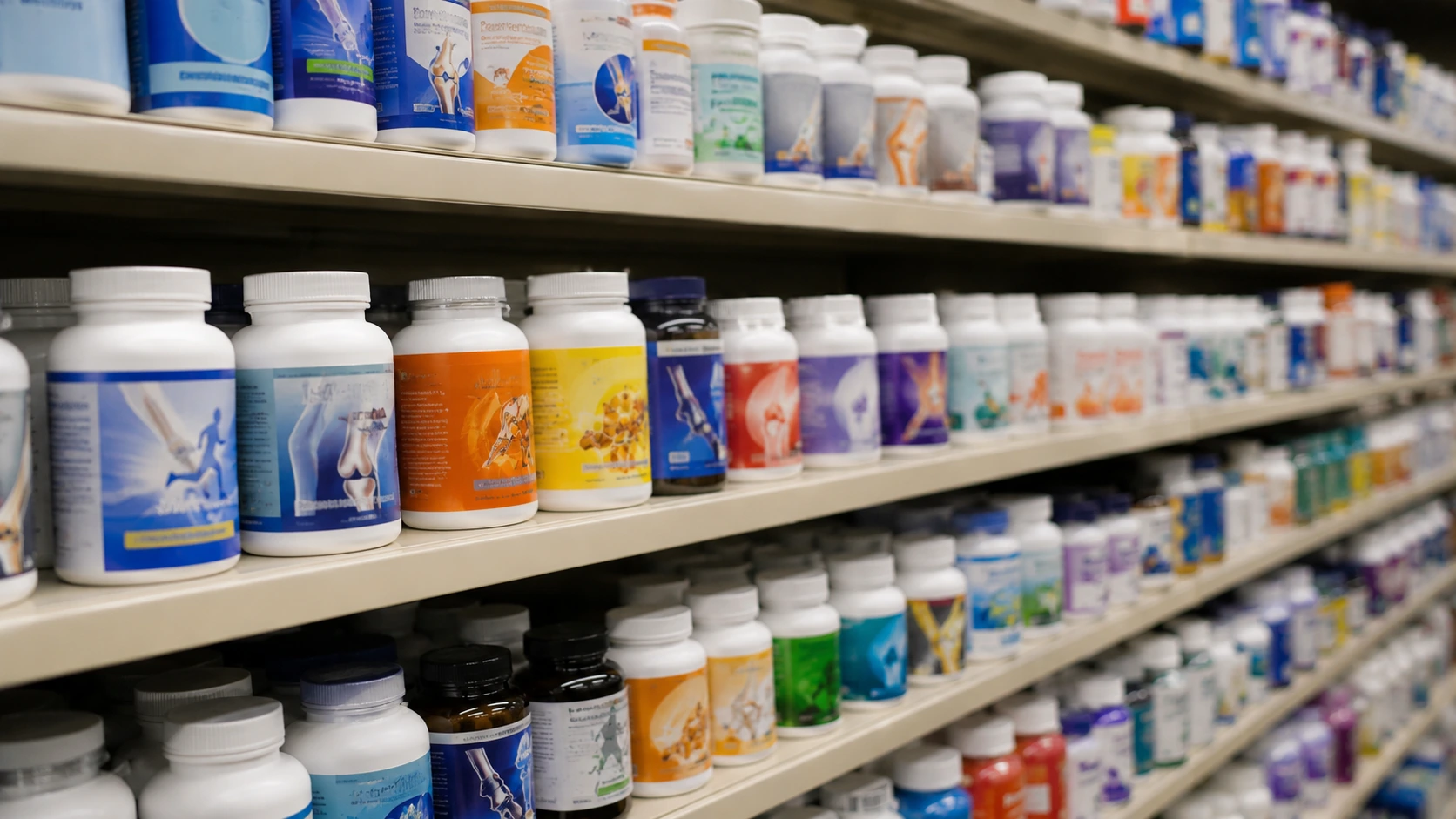
Most joint supplements target cartilage or inflammation — none of them address the fluid drought happening inside the joint.
Glucosamine and chondroitin were designed to rebuild cartilage.
But cartilage breakdown is only one of three problems — and multiple large-scale studies have shown they don't even do that effectively for most people.
Turmeric and fish oil target inflammation. But inflammation in a dried-out joint is a symptom, not a cause.
Calming it without restoring the fluid is like sweeping dust off a dry riverbed instead of bringing the water back.
Collagen powders give your body raw materials.
But without healthy synovial fluid to deliver those nutrients to the cartilage — remember, cartilage has no blood supply of its own — they pass through your system without reaching where they're needed.
Hyaluronic acid injections are the closest thing to addressing the actual problem. But they wear off in weeks, cost hundreds per session, and can't trigger your joints to produce their own fluid.
They're a temporary refill, not a restart.
Each of these approaches targets one piece of the puzzle at best. None of them addresses all three — fluid, cartilage, and inflammation — simultaneously.
And none of them triggers your body's own fluid production, which is where the entire cycle begins.
That's why Robert spent ten years trying and failing. Not because he wasn't persistent enough.
Because the things he was trying were never designed for the actual problem.
→ Check current Arthrozene pricing and availability
Why Dr. Karanastasis Is Sharing This
Dr. George Karanastasis reviewing clinical trial data. "Nobody was asking why the fluid was disappearing in the first place."
Over 300,000 Americans have now tried the same approach Robert discovered.
Truck drivers. Retired teachers. Grandparents who were told to just manage it. People who'd been getting cortisone shots for years and quietly stopped needing them.
Dr. Karanastasis has heard every version of this story. A few in particular stay with him.
Richard from Montana. At 62, he had nearly given up on the elk hunting trip he'd been planning with his 15-year-old grandson.
"One year ago I had begun to doubt ever making this trip," he wrote.
He went anyway — into the Custer and Gallatin National Forests, at 7,000–8,000 feet altitude, walking through a foot of snow.
"Finding this formula has certainly been a game changer. I now can believe there will be many extreme outdoor adventures ahead for us."
Judy from New Hampshire described what it felt like to go upstairs before Arthrozene: needles going through her knees on every step.
Within two weeks, the needles were gone.
Robin, a 66-year-old ranch owner in Texas, had been confined to his office desk for over a year because sitting was the only position that didn't hurt.
His own orthopedic surgeon — a knee specialist — had told him not to get surgery unless it was a last resort.
After less than one bottle of Arthrozene, he was back in and out of his tractors, backhoe, and bobcat.
"I have a new outlook on life," he wrote. "I hope to retire at 70 and still have energy to enjoy the fruits of my labor."
What makes these stories more than anecdotes is what happened when people stopped.
Some stopped because they felt so good they figured they didn't need it anymore. Others ran out and didn't reorder in time.
One customer deliberately stopped for 45 days just to test whether it was really the Arthrozene making the difference.
Every one of them reported the same thing.
The stiffness came back. The discomfort crept in. The mornings got harder again.
And every one of them restarted — and watched it go away.
When people stop taking it and the pain comes back — then restart and it goes away again — that's not placebo.
That's something real happening inside the body.
→ See today's special pricing and choose your package
Which raises the obvious question: if you started today, what would that actually look like?
But before we get to that, there's something worth putting in perspective.
What Joint Problems Actually Cost
If you're like most people dealing with chronic joint stiffness, you've already spent more than you'd probably like to admit trying to find something that works.

Years of doctor visits, failed supplements, and cortisone shots — and nothing addressed why the joints were drying out in the first place.
Glucosamine — $30 to $50 a month. You probably took it for six months, maybe a year, before quietly admitting it wasn't doing much.
That's $360 to $600, gone.
Turmeric, fish oil, collagen powder — another $40 to $80 a month, sometimes on top of the glucosamine.
Maybe you're still taking some of them right now, more out of hope than evidence.
Cortisone shots — $500 to $2,000 each, depending on your insurance.
And the relief, if it came at all, lasted a few weeks before the stiffness crept right back.
Robert got four of them in a single year. That's up to $8,000 for temporary relief that didn't address what was actually happening inside his joints.
And then there's the option his doctors kept recommending: joint replacement surgery.
$30,000 to $50,000 per knee. Six to twelve months of recovery. And no guarantee the stiffness won't return in the other joints.
Add it all up, and the average person with chronic joint problems spends somewhere between $3,000 and $10,000 a year.
Managing a condition that keeps getting worse — because nothing they're spending money on was designed to address the fluid.
But the real cost isn't on any receipt.
It's the mornings you've spent gripping the edge of the bed.
The invitations you've turned down because you didn't know if your knees would cooperate.
The grandkids you've watched play from a chair instead of joining them on the floor.
That's the price you've been paying every day — and no supplement on the pharmacy shelf was ever going to give that back, because none of them were designed for the actual problem.
Dr. Karanastasis could have sold Arthrozene through pain clinics at ten times the price.
The ingredients justify it — three trademarked compounds, two of them patented, developed by pharmaceutical research teams in Spain, each dosed at the exact levels used in clinical trials.
Instead, he made it available direct — no pharmacy markups, no doctor's office billing, no insurance middlemen. Just the formula, shipped to your door.
The result: a 30-day supply of all three clinically studied ingredients costs roughly a dollar a day.
Less than a cup of coffee. Less than a single glucosamine capsule that wasn't addressing the actual problem.
What Happens After You Start

Most Arthrozene customers report feeling the first real difference within the first two weeks.
Every person is different. But based on more than 300,000 customers, a pattern has emerged.
Days 1–5
Building up
Most people don't feel much yet. The ingredients are building up in your system.
Mobilee® is beginning to signal your joints to produce fresh fluid.
Some people — roughly one in five — notice a subtle difference as early as day 2 or 3. Most don't. That's normal.
Days 5–14
First shift
This is where most people feel the first real shift.
The mornings get a little easier. The stiffness that used to take ten minutes to shake off starts loosening in five.
You might catch yourself getting up from a chair without bracing.
Weeks 3–6
Compound effect
The compound effect kicks in.
The fluid production triggered by Mobilee® is now sustained. Collavant n2® is actively slowing cartilage breakdown. ApresFlex® is calming the inflammatory buildup.
Activities that had quietly dropped off your list — walking the dog a full mile, taking the stairs without thinking, kneeling in the garden — start showing back up.
Months 2–3
Dramatic changes
This is where the most dramatic changes tend to happen.
Robert's discomfort was gone by month two. The stem cell patient cancelled his procedure after one month.
Several customers stopped their cortisone shots entirely during this window.
Month 3+
Long-term results
The longer you take it, the more it builds.
Richard went elk hunting at 8,000 feet with his grandson. Robin was back on his ranch full-time.
The customers who've been on Arthrozene for a year or more consistently say the same thing — they'll never stop taking it.
But there's one more thing worth understanding about joint drought.
It doesn't hold still.
The fluid loss that's happening inside your joints right now is cumulative.
Every month that passes, a little more dries out. The cartilage that depends on that fluid for nutrition gets a little more exposed.
The inflammatory waste that the fluid would normally flush away builds up a little more.
Dr. Karanastasis puts it simply: the people who see the most dramatic results are the ones who start while there's still fluid production to reactivate.
Mobilee® works by triggering your body's own cells to produce fresh fluid — but those cells need to be functional enough to respond.
The earlier you start, the more you have to work with. And the longer you wait, the harder every month of recovery becomes.
You now know something most people never learn — what's actually causing it, and what the research shows can be done about it.
What Dr. Karanastasis Recommends
Dr. Karanastasis's team has made Arthrozene available directly — no prescription needed, no middlemen, no auto-ship.
One capsule per day. Three trademarked ingredients at their clinically studied doses.
The formula has sold out three times this year.
Because the key ingredients are sourced from Spain and go through multiple rounds of testing before release, production runs are limited — and the team can't guarantee availability between batches.
If you've been dealing with stiffness for less than a year, the 30-day supply lets you see how your body responds.
If it's been longer — and for most people reading this, it has — the 3- or 6-month supply is where the compound effect really takes hold.
That's the window where Robert's discomfort disappeared entirely, where Richard went elk hunting at 8,000 feet, and where Robin got back on his ranch full-time.
Your order is protected by a 365-day money-back guarantee.
If you don't feel a meaningful difference in your comfort, mobility, or morning stiffness — for any reason — you get a full refund. No questions asked.
→ See If Arthrozene Is Still Available In Your Area → Check Availability & See Today's Pricing365-Day Money Back Guarantee · Free US Shipping · One-Time Purchase · No Autoship
The First Day
The most common thing Dr. Karanastasis hears from customers after they've been on Arthrozene for a while isn't about the pain level or the stiffness score.
It's about a specific moment.
They call it their first day.
The first morning they got out of bed and realized — sometime during breakfast, or on a walk, or later that afternoon — that they hadn't thought about their joints once.
No mental inventory of what's going to hurt.
No unconscious planning around stairs or chairs or distances.
Just a normal day. The kind they used to have before all of this started.
"Around 10 days I noticed I was no longer waking up with knee and back aches. I am now back playing golf 2 or 3 times a week."
— Stanley, 81, Englewood, Florida
"After 11 days I began to notice less pain. After two full weeks, I was no longer limping, my knuckles were not swollen, and my pain was eliminated. I have never used a product that has had such an impact."
— T. Griffin, Verified Customer
"It solved the problem of aching and nonfunctional fingers and hands."
"I wondered if I still needed these capsules and stopped taking them. The pain returned. I could hardly wait to go back."
"Now I can use my hands again, even to shuffle cards in games with my grandkids."
— Pennie Crutchfield
You Have Two Options
Option 1: Close this page and continue doing what you've been doing.
Keep trying supplements that only address symptoms. Keep waking up stiff. Keep avoiding the activities you used to love.
The slow, invisible drought happening inside your joints right now.
Over 300,000 people have already made this choice.
Many of them had tried everything else first.
And if it doesn't work for you, you're covered by a full 365-day money-back guarantee.
You risk nothing.
→ See the Joint Drought Formula & Today's Special Offer → Check Availability & See Today's Pricing365-Day Money Back Guarantee · Free US Shipping · One-Time Purchase · No Autoship
References:
1. Wallace IJ, Felson DB, Lieberman DE. "Knee Osteoarthritis Has Doubled in Prevalence Since the Mid-20th Century." Proceedings of the National Academy of Sciences 114, no. 35 (2017): 9332–9336. 2. Castillo M, Martinez-Puig D, et al. "Stimulation of endogenous hyaluronic acid synthesis by synoviocytes following exposure to a rooster comb extract rich in hyaluronic acid." Osteoarthritis and Cartilage 18, Suppl 2 (2010): S244–S245. 3. Kalman DS, et al. "Effect of a natural extract of chicken combs with a high content of hyaluronic acid on pain relief and quality of life in subjects with knee osteoarthritis." Nutrition Journal 7 (2008): 3. 4. Bakilan F, et al. "Effects of Native Type II Collagen Treatment on Knee Osteoarthritis." Eurasian Journal of Medicine 48 (2016): 95–101. 5. Di Cesare Mannelli L, et al. "Low-dose chicken native type II collagen is active in a rat model of osteoarthritis." BMC Musculoskeletal Disorders 14 (2013): 228. 6. Sengupta K, et al. "Comparative efficacy and tolerability of Aflapin® in osteoarthritis of the knee." International Journal of Medical Sciences 7, no. 6 (2010): 366–377. 7. Vishal AA, et al. "Early efficacy of Aflapin® in subjects with osteoarthritis of the knee." International Journal of Medical Sciences 8, no. 7 (2011): 615–622. 8. Kocak E, et al. "TRPV1 and joint inflammation." Rheumatology 59, no. 3 (2020): 662–670.